


If you were to ask most folks you run into on the street what they think about UFOs, you're sure to get an amalgamation of answers – some positive, some negative, maybe most being fairly neutral. Ask the public about UAPs, however, and many won't recognize what you're referring to.
What is a UAP? 'UAP' stands for Unexplained Aerial Phenomenon, otherwise known as 'things up in the sky we simply have no explanation for.' UAPs have, thanks to the efforts of a handful of determined individuals and organizations, suddenly been thrust into the public eye and subsequently confirmed by the U.S. government to be very real. Thanks to the madness of the time we currently live in, however, the government quietly admitting this fell largely to the wayside.
But read that again: The United States government admitted that unidentified objects are present in our skies. They admitted that, essentially, UFOs absolutely do exist, though we're just not calling them that anymore. The U.S. Navy now has official guidelines for service members to report sightings of these objects.
This should be a much larger deal than it is, if you ask us.
So, then, what's the difference between a UFO and a UAP? Not a whole lot, except that 'UAP' seems to be significantly more socially acceptable to discuss publicly than UFOs have ever been, thanks to legitimizing by the U.S. government itself. Today, we'll examine the story so far: the events that kicked off the current storm of information surrounding Unidentified Aerial Phenomenon, the who's who of characters in this story, and, of course, the now-famous videos that changed everything. Let's take a journey into the world of high strangeness which, it seems, might not be so strange after all. Let's dive in.
The First Leak: A Decade of Silence
Our story begins not in 2017 with mainstream media coverage, but a full decade earlier in the depths of internet forums. In 2007, an anonymous user posted what would eventually become known as the FLIR1 video on a conspiracy and UFO-centered forum called Above Top Secret. The user claimed they had ripped the footage directly from the Navy's SIRPNET server, but the forum's community didn't believe a word of it.
The user was ridiculed, their story was dismissed as fabrication, and after enduring mockery from even fellow UFO enthusiasts, they eventually stopped posting altogether. The video quickly faded into the background noise of the internet and was forgotten. It didn't help that someone traced the video's upload back to a German website specializing in special effects – though this was later revealed to be simply because the leaker wanted to store the evidence on a server outside the United States to avoid potential legal consequences.
One can only imagine the frustration and vindication that anonymous poster must have felt a decade later when their "fake" video was confirmed as authentic by the Pentagon itself.
The 2004 Nimitz Encounter
To understand what that anonymous poster had leaked, we need to go back to November 14, 2004. Off the coast of Southern California, the USS Princeton's highly advanced radar had been picking up mysterious objects for several days. These objects would drop out of the sky from 80,000 feet and rapidly descend to sea level in seconds, displaying flight characteristics unlike anything in the known aircraft inventory.
Commander David Fravor and Lieutenant Commander Alex Dietrich, flying F/A-18 Super Hornets from the USS Nimitz, were dispatched to investigate. What they encountered would become one of the most documented UAP incidents in military history. Fravor described a white, oval object about 40 feet long – roughly the size of his fighter jet – with no visible wings, engines, or exhaust. The object appeared to react to their presence and, when Fravor attempted to intercept it, accelerated away at speeds that defied conventional understanding of physics.
An hour later, another pilot, Lieutenant Chad Underwood, was sent to the same area and managed to capture infrared video of what appeared to be the same type of object. This footage would remain classified for over a decade.
YouTube Video: FLIR1 - The 2004 Nimitz UAP encounter footage
The Pentagon's Secret Program
Unknown to the public, the U.S. government had been quietly studying these phenomena through a program called the Advanced Aerospace Threat Identification Program (AATIP), which operated from 2007 to 2012 with $22 million in funding. The program was tasked with investigating reports of unidentified aerial phenomena and was directed by Luis Elizondo.
According to investigative reporting by The New York Times, AATIP made case reports, studied correlations between sightings, and examined the behaviors and characteristics of unidentified objects. Pentagon briefings from this period contained the startling assessment that "what was once considered science fiction is now science fact," and noted that the U.S. currently had no way to defend against these objects and their apparent technology.
When AATIP's funding ended in 2012, Elizondo continued working on UAP investigations with the Navy and CIA until October 2017, when he resigned in protest of what he called "excessive secrecy and internal opposition." His departure would prove to be a catalyst for public disclosure.
My pledge to you:
— Lue Elizondo (@LueElizondo) August 22, 2020
1. I will always tell you the truth
2. I will own my mistakes and hold myself accountable
3. Everyone will be treated with respect, no matter their position
4. Abuse or hatred towards others will not be tolerated
5. I will always push for full disclosure.
Twitter Post: Luis Elizondo's transparency pledge following his Pentagon resignation
To the Stars Academy
While Luis Elizondo was fighting bureaucratic battles within the Pentagon, an unlikely figure was assembling his own team of UAP researchers. Tom DeLonge, best known as the guitarist and vocalist for the pop-punk band Blink-182, had spent years cultivating relationships with government insiders and scientists interested in aerial phenomena.
DeLonge's path to UAP research began in the most unlikely of places: a Lockheed Skunk Works employee event where he was invited to introduce the company's leadership. What started as a chance meeting evolved into high-level discussions with officials from the world's most advanced aerospace development programs.
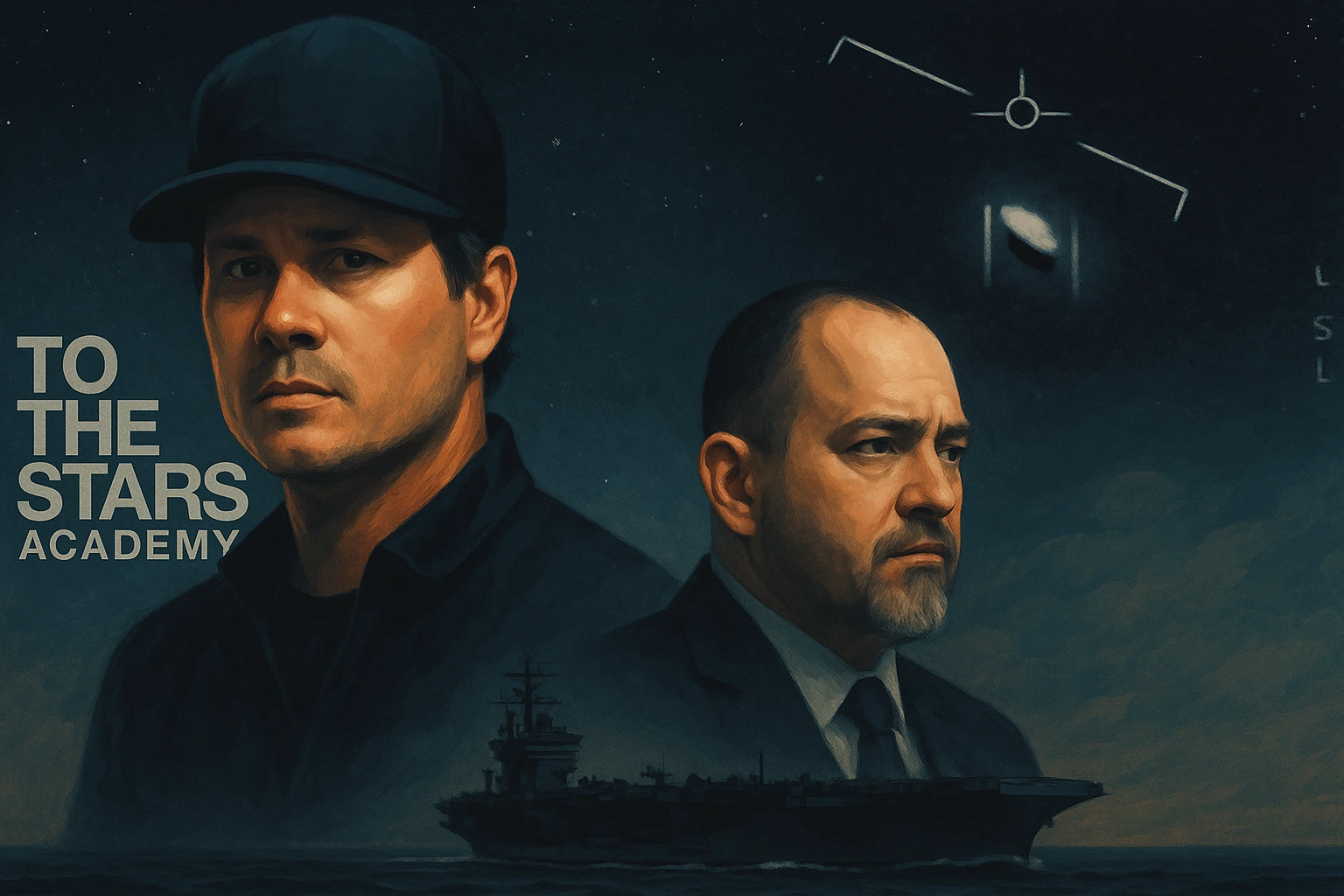
In October 2017, DeLonge announced the formation of To the Stars Academy of Arts & Science, a public benefit corporation dedicated to advancing research into unexplained phenomena. The organization brought together an impressive roster of former government officials, including Elizondo, who joined shortly after his Pentagon resignation, along with former CIA operative Jim Semivan and physicist Harold Puthoff.
What made To the Stars Academy credible wasn't DeLonge's celebrity status, but the credentials of his associates. These were serious people with decades of experience in intelligence, aerospace, and scientific research. DeLonge himself was named OpenMinds.tv's UFO Researcher of the Year in 2017, recognizing his role in bringing together this unprecedented team.
PLEASE WATCH: Public company launched to investigate UFOs lasvegasnow.com/news/i-team-pu…
— Tom DeLonge (@tomdelonge) October 12, 2017
Twitter Post: Tom DeLonge announces To the Stars Academy's UFO investigation mission
The December 2017 Breakthrough
On December 16, 2017, To the Stars Academy, in coordination with The New York Times, released what would become one of the most significant stories in UAP history. The newspaper published the exposé titled "Glowing Auras and 'Black Money': The Pentagon's Mysterious U.F.O. Program" by Helene Cooper, Ralph Blumenthal and Leslie Kean, revealing the existence of AATIP and releasing the first two UAP videos to mainstream media. The Washington Post also published related coverage that same day.
The videos – FLIR1 (from the 2004 Nimitz incident) and GIMBAL (from a 2015 encounter off the East Coast) – showed objects performing maneuvers that seemed to defy the laws of physics. Unlike the countless blurry UFO videos that had circulated on the internet for decades, these came with official Pentagon provenance and the testimony of experienced military pilots.
YouTube Video: GIMBAL - The First Official UAP Footage from the USG for Public Release
A Political Connection: John Podesta's UFO Advocacy
The UAP disclosure movement found an unexpected ally in Washington establishment circles through John Podesta, former White House Chief of Staff under Bill Clinton and campaign chairman for Hillary Clinton's 2016 presidential campaign. Far from being a casual observer, Podesta had been a vocal advocate for government transparency on UAP issues for decades.
Check out Tom DeLonge's launch of To The Stars-AAS #LeapForward #TheTruthIsOutThere bit.ly/2zgfab8
— John Podesta (@johnpodesta) October 11, 2017
Twitter Post: John Podesta endorses Tom DeLonge's To the Stars Academy launch
According to leaked emails published by WikiLeaks, Podesta had extensive communications with UAP researchers, including Tom DeLonge. In one email exchange, DeLonge wrote to Podesta about wanting to introduce him to "very important people" with leadership roles in "classified science and DoD topics."
Podesta's interest wasn't merely academic. In February 2015, upon leaving his role as counselor to President Obama, he tweeted: "Finally, my biggest failure of 2014: Once again not securing the disclosure of the UFO files." The emails also revealed communications with Apollo 14 astronaut Edgar Mitchell, who urged Podesta to discuss "extraterrestrial disclosure" and alleged alien technology.
Hillary Clinton herself pledged during her presidential campaign to declassify UAP-related government files if elected, demonstrating how the issue had gained traction even at the highest levels of American politics.
The Third Video and Official Confirmation
In March 2018, To the Stars Academy released a third video, known as GOFAST, which showed another encounter between Navy pilots and an unidentified object. This video, captured in 2015 by an F/A-18 Super Hornet off the East Coast, showed what appeared to be an object moving at high speed just above the ocean surface.
YouTube Video: GOFAST - Official USG footage of UAP for public release
The three videos created a sensation, but questions remained about their authenticity and official status. That changed in September 2019, when Navy spokesperson Joseph Gradisher confirmed that the videos were genuine and that the objects depicted were officially classified as "unidentified aerial phenomena."
The confirmation was significant not just because it validated the videos, but because it represented a fundamental shift in how the U.S. military approached the UAP topic. For decades, military personnel had been discouraged from reporting strange sightings due to career concerns and stigma. The Navy's acknowledgment signaled a new era of transparency and scientific inquiry.
Congressional Action and Official Investigation
The momentum created by the video releases and media coverage eventually reached Congress. Following Elizondo's vocal departure from the Pentagon and subsequent interviews, congressional leaders began asking questions about UAP encounters and their implications for national security.
In 2020, AATIP was officially renamed the UAP Task Force, later evolving into the All-domain Anomaly Resolution Office (AARO). The program expanded its scope beyond simple documentation to active investigation of encounters, including crash retrieval operations.
Leslie Kean's continued reporting revealed that Navy pilots had been encountering small, drone-like objects capable of remaining airborne for more than 22 hours during the 2014-2015 timeframe. Navy F/A-18 pilots disclosed that these encounters became so frequent they filed official safety reports. In one dramatic incident, an object described as "a sphere encasing a cube" flew directly between two F-18 fighters that were flying just 100 feet apart off the Virginia coast.
What made these encounters particularly intriguing was their connection to advanced radar technology. According to pilot testimonies, the objects only became detectable after Navy fighters received upgraded AESA radar systems. As one pilot noted, objects could stay airborne for 12 hours – "11 hours longer than we'd expect" for any conventional aircraft. Even more puzzling, the objects would show up clearly on radar but remain completely invisible to pilots, even when using advanced helmet-mounted cameras.
The reporting team behind the original 2017 breakthrough continued their groundbreaking work, building on these initial revelations with subsequent investigations into crash retrieval programs. Their later reporting suggested that high-level government officials had been briefed on potential recoveries of unidentified materials, though this came with significant controversy. Former Senate Majority Leader Harry Reid, who had originally helped fund AATIP, initially appeared to support claims about crash retrievals but later walked back his statements, posting on social media that he had "no knowledge" of recovered materials and criticized "fairy tales about little green men." This reversal highlighted the ongoing sensitivity and classification issues surrounding the most explosive aspects of UAP research, even as the basic reality of the phenomena gained official acknowledgment.
The Pentagon Makes It Official
On April 27, 2020, the Pentagon took the unprecedented step of officially releasing all three videos. In a statement, the Department of Defense said it was "releasing the videos in order to clear up any misconceptions by the public on whether or not the footage that has been circulating was real. The aerial phenomena observed in the videos remain characterized as 'unidentified.'"
This official release represented a complete reversal of decades of government policy regarding UAP disclosure. The same videos that had been dismissed as hoaxes or classified secrets were now being presented by the Pentagon itself as legitimate documentation of unexplained phenomena.
The vindication was particularly sweet for the anonymous forum poster who had leaked the FLIR1 video in 2007, only to be ridiculed and ignored. Their lone act of disclosure had, ten years later, helped spark a global conversation about one of the most profound questions facing humanity: Are we alone in the universe?
What Comes Next
The release of these three videos marked not an ending, but a beginning. They opened the door to a new era of scientific inquiry into aerial phenomena, backed by official government acknowledgment and military testimony. While the objects in the videos remain unidentified, their existence is no longer in question.
Whether these phenomena represent advanced foreign technology, natural atmospheric effects, or something else entirely remains to be determined. What is certain is that the age of government secrecy and public ridicule surrounding UAP reports appears to be coming to an end, replaced by legitimate scientific investigation and unprecedented transparency.
The story of these three videos – from anonymous forum post to Pentagon confirmation – illustrates how truth can emerge even when official channels fail. Sometimes it takes a rock star, a handful of dedicated researchers, and one persistent whistleblower to change the world's understanding of what's possible in our skies.